
|
Flea Information page
|
|
Scientific Names:
The Cat flea : Ctenocephalides felis (Bouche)
The Dog flea: Ctenocephalides canis (Curtis) |
|
| Appearance: |
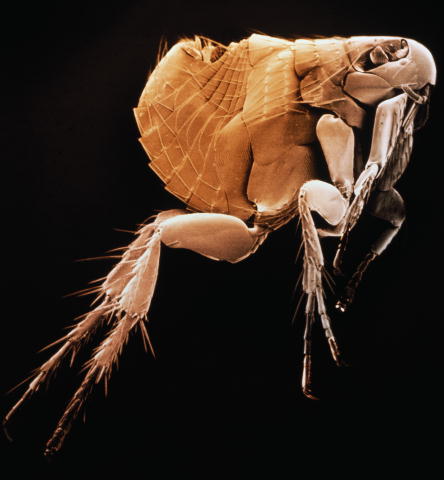
Cat and dog fleas can
be found in the same areas. They are very similar in appearance. They are
small, 1/8-inch long, wingless, laterally flattened, and have piercing-sucking
mouthparts. The flea has very well-developed legs allowing it to jump at
least six inches straight up. They are black-to-reddish brown. Its body is
covered with backward projecting spines which help it to move between the
hairs on the host animal. The head of the female cat flea is twice as long
as it is high; the head of the female dog flea is less than twice as long
as it is high. Both cat and dog fleas have a row of very heavy spines on
the front of the head (i.e., the genal comb) and the back part of the first
body segment (i.e., the pronotal comb). Cat and dog flea larvae are 1/4-inch
long when fully developed. They look much like fly maggots except for their
well-developed heads. They have 13 body segments and are dirty-white in color
with backward projecting hairs on each body segment.They have a pair of hook-like
appendages on the last abdominal segment. |
Breeding
Information: |
Cat and dog fleas undergo complete metamorphosis. After eachblood
meal, females lay four to eight eggs at a time (but 400 to 800total within
her lifetime) on the host animal and/or in its bedding. Theeggs fall into
the nest and/or bedding of the host animal or wherever theanimal happens
to be at that time. The eggs hatch in about 10 days, and the developing larvae
feed on the adult flea feces which contain bitsof dried blood. Depending
on temperature, they molt three times in from seven days to several months.
When mature, they spin silken cocoons in which they pupate. The pupal stage
lasts up to 20 weeks. The adult cat flea often stays within the cocoon until
vibrations stimulate it to emerge. Development (egg to adult) requires from
16 days to a year or more. |
| Activity |
Habits: Adult fleas feed on blood with their piercing-sucking
mouthparts. They typically seek a blood meal within two days of becoming
an adult. Cat and dog fleas prefer these two animals butreadily feed on other
animals, e.g., racoons, opossums, rats, andhumans. Adult fleas remain on
the host animal throughout their lifetime but are occasionally knocked off
the animal by scratching.Occasionally, they can be found in the pet bedding
and resting areas.Wild animals nesting in structures can initiate indoor
flea populations.Larvae typically are found in areas where pets spend most
of their time as well as in animal nesting areas. |
| Control: |
Effective flea control requires customer cooperation and
involves three major steps: sanitation, insecticide application, and on-animal
flea control. The house should be thoroughly vacuumed toremove larvae, pupae,
and food materials. The vacuum cleaner bag should be sealed and discarded
immediately after vacuuming.Vacuuming lifts the carpet fibers removing debris
which, in turn, allowsthe pesticide to penetrate to the base of the carpet
where the flea larvae are found. Pet bedding should be discarded or
washed in hot, soapy water.
Indoors, residual insecticides in combination
with an insect growth regulator which blocks development of the flea larvae
should be applied to carpeted areas, furniture where pets reside, and cracks
and crevices on hard floors. Humans and pets should remain out of the treated
area until all surfaces have dried and the area has been ventilated. Outdoor
areas which are frequented by the pet should be treated at the same time
that the house is treated using microencapsulated or wettable powder
formulations. These products should be applied either as a spot treatment
to areas frequented by the animal or as a broadcast treatment.
The pet should be treated by a veterinarian,
pet groomer, or the owneron the same day on which the house is treated. Numerous
products are available for on-animal flea control, e.g., pills containing
an insect growth regulator, spot-on adulticides, flea collars, on-animal
insect growth regulators, soaps, dips, etc. Regardless of the treatment, adult
fleas must be eliminated from the animal in order for treatment to be effective.
Technicians should never apply any product to an animal. |
Back
|
Contact Us
1800/427-0002
|